Behind the scenes with interactive graphics journalists Cedric Sam

By: Ryan Mannion and Cory Guillory
More than six months to Global Pandemic, data about the Covid-19 cases and deaths are still everywhere. Last week, the team at Bloomberg Graphics News shared a new view of how important we were thinking about the location and boundaries with the right context in their article “Mapping Coronavirus: How many Covid-19 cases are near you”. Visualization 🔥 they were built partly with mapbox fire so we took the time to talk to Cedric Sam from the Bloomberg Graphic Team (@Bbgvisalata) To learn more about their journey to issue this story.
What inspired you to tell this story?
We begin with the belief that the Covid number by the state, especially nationally, is too broad and that district level data is often too rare. We look into what will happen if we expand aggregation outside the administrative or metropolitan limits that we usually read for more regions that reflect how people really move in their daily lives.
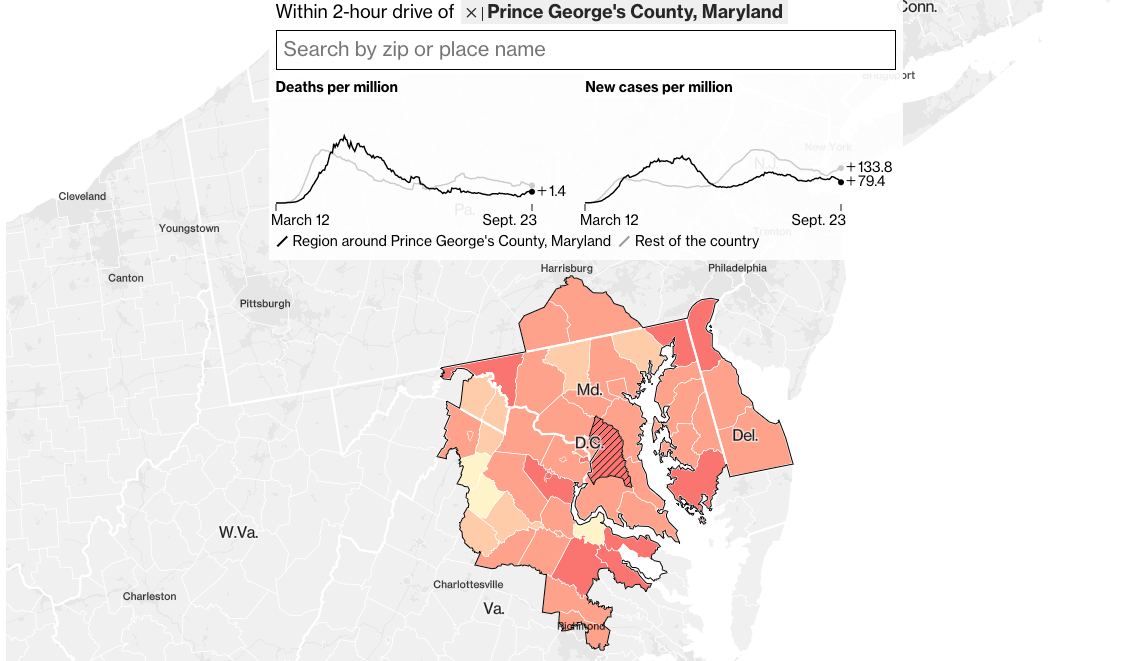
The result is an interactive visualization where readers can get information that can tell a story that is different from what someone hears about local or even national news. They can enter the location of their choice and then switch between seeing daily deaths and new cases in the district within two hours of driving from that location. There is a time slider at the bottom that starts on March 12 and passes today, and then there is a dynamic line chart sitting on a map that compares the designated area with all countries in cases and deaths.
Run us through some of the most interesting examples that you find that shows how important this type of location context is.
Interactive really allows you to dig into the connected area. Take Ripley Regency in Indiana, a rural area consisting of 28,000 population, but within a range of 2 hours drive by 7.3 million people who live in city centers such as Ringinna, Indianapolis, and Louisville.
The other is California. The Fresno area in San Joaquin Valley and the area around San Francisco and Silicon Valley is right next to each other, but the first to be beaten much harder this summer.

Explain how you build this visualization.
We use the Covid-19 District Level and Death Dataset from our friends @nytgraphics Across the city, which we solve it into a one -County piece that updates at least once a day.
To identify the most reliable driving distance between districts, we ask the Mapbox Matrix API for each region or area equivalent to the United States of something like 100 or more of their closest neighbors. Then, using Svelte and Mapbox GL JS, we make a map interface with a special search box that allows users to choose a particular place, which takes up to several dozen historical data files for each region in the 2 -hour drive.
We do heavy geoproes on the base map using various tools, including dirty reprojectors and maps, tools from NYT Matthew Bloch graphics editors.
What challenges do you face with this article and how do you finish it?
Getting driving distance for each region is one of the more difficult technical parts than the project.
To determine the closeness between the district, we are not sure whether to use centroids from each region or external limit and calculate the distance of straight lines will be the best size. We determine that a representative city in County, which is a county seat in 98% of the district, is the point per county that we want and uses dataset from the point. We also decide that driving distance is a better metric to calculate connectedness, even if it is a more difficult thing to obtain (it seems that no data has been counted out there).
Now, how will we measure connectedness for all 3,000 or more districts or regional equality in the US? We initially saw the Isochrone mapbox fire, but the maximum distance was 60 minutes, which was not far enough for the district. So we see the distance of driving fire out there that we can use and finally choose Mapbox’s Matrix API. To be able to measure driving distance between all 3,000+ countries with 2,999, we do several pre-processing to reduce the number of fire calls.
After getting a distance data, we describe it and make a concise structure, then registered in the state in 7,200 seconds for each region, using their FIPS identification.
The dirty reprojector technique mentioned above also adds another layer of complexity in dealing with user interactions. The point on the map that interacts with the reader does not equate with the actual pair of latitude and longitude. Conversely, they are the points around Null Island, the name for the point on the surface of the earth where the main meridian and the Equator Cross. So, every user interaction (every touch of a map) is a query that must determine the polygon of our touched mapbox map. And then, the cascade of the function (involving the use of grass to make contours around the selected area) will visualize the selection of maps and line charts on the map.
Do you have unexpected learning while compiling this?
Building this interactive gives us the possibility of starting with a high level of external observation and can explore to determine that there is indeed a significant difference between adjacent areas. For example, we have heard that for about a week, cases in North Wisconsin have risen. Visual shows that on September 21, there are two new number of new cases per capita around Wausau rather than around Madison. Conversely, you can start with the area of your residence that may not be known because it has many cases per capita, and then see from interactive that you live in a distance driving close to the area that sees the increase in cases. I think it is a very strong feature of our project. We check this more On Twitter.
Is there anything else we don’t ask about that you want to share?
To encourage readers to explore and share what they think is interesting, we add the hash to the main url when they interact with graphics and find interesting places. For Chicago, you can save and share this view, for example. (Instructions: Get Sharing!)
Game Online
Berita Olahraga
News
Berita Terkini
Berita Terbaru
Berita Teknologi
Seputar Teknologi
Drama Korea
Resep Masakan
Pendidikan
Berita Terbaru
Berita Terbaru
Berita Terbaru
A gaming hub can refer to a central platform or space dedicated to gaming, where players can access games, interact with other gamers, and enjoy related content.
