By creating flood risk data available freely for all with floodfactor.com, the First Street Foundation Non -profit complements individuals and communities throughout the United States to better understand and prepare floods and changing environments.
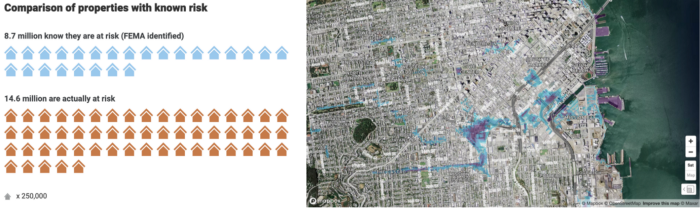
Flooding is the most expensive type of natural disaster in the United States, with a cost of more than $ 1 trillion in dollars that are tailored to inflation since 1980. While institutional real estate investors and insurance companies have access to detailed property flood risk data for years, the majority of Americans have relying on a map of the Federal Emergency Management Agency (FEMA). However, the Fema map was not created to model floods at the level of individual nature, leaving millions of households and property owners who were unaware of their true risk.
The flood factor was created to overcome the gap of knowledge. For example, I can quickly drill to Hoboken, New Jersey to see the most risky area.
Or I can find the 20002 postal code in the Columbia District – and see that there are “increased risks” and 2,385 properties that are expected to be at risk of flooding in only 30 years.
Our goal is to make the most recent flood data freely accessed by all, using a simple 1-10 score that gives property owners direct way to understand the risk of flooding on what might be the biggest and most valuable financial assets: their homes.
– Matthew Eby, Executive Director, First Street Foundation
The most important element of the flood factor is its simplicity. Behind the scenes, the team at the First Street Foundation has created the first methodology-from-type that adjusts the changing climate reality and how it will have an impact on the risk of flooding into the future, contributes local adaptation, and combines four main contributors to floods: Tidal, Rain, Riverine and Storm Surge, all at the level of granularity needed to calculate the risk of individual floods. Apart from the complexity of modeling, user experience can be accessed and attractive.
The ‘map score’ feature flood factor allows users to visualize changes in risk nature and make data more enjoyable. By doing a collection of scores together when users enlarge and exit, interactive maps allow them to understand the risk of their floods relative to other properties in a simple and visually attractive way.
Partnering with mapbox is very important to give us innovative ways to integrate locations into flood factors and improve user experience. Our score map is one of the most popular components of this site.
– Colleen Ensor, Product Manager, First Street Foundation
The address search on the home of the flood factor, powered by Mapbox Geocoding API, brings users directly to the content that is relevant to them and their community. For optimized user experience, maps on the site use Mapbox GL JS for dynamic maps and static ‘snapshot’ maps to help direct the user.
To calculate flood risk scores at the individual property level, the First Street Foundation uses building footprint data (from Mapbox, Microsoft, and OpenStreetmap) combined with parcel data from Lightbox. A collection of flood risk data produced is processed into vector tiles and arranged in Mapbox Studio. The finished map features a number of data-based style techniques and zoom-based zooms on how to replicate this in the Mapbox studio, directly in the GL JS code using expression, or by editing the paint property.
Since it was launched in June, Factor Flood has triggered new conversations about floods and flood preparedness, both in the scientific community, the media, and the general public. Through partnerships with Realor.com, the flood factor now also reaches millions of homeowners today and the future to help them understand the risk of flood property because of the environment that changes during the 30 -year mortgage.
Our goal is to always democratize information that has long been inaccessible because of its complexity and cost. We have heard from people throughout the country who have used floods to help make important decisions about whether to buy flood insurance, and other investments to protect their homes.
– Matthew Eby, Founder and Executive Director, First Street Foundation
The First Street Foundation also shares their data with others who work at the risk of flooding. The non-profit, academics, and the public sector can access statistics on the summary of aggregate flood risk for public use, non-commercially through public dataset AWS and others can buy access through API. Leading Academic and Industry Researchers collaborate as part of the First Street Foundation flood lab to gain new insights and further understanding of the risk of flooding, consequences, and possible solutions. Other projects that are already like an environment that risk endangers flood factors to help the community prioritize improvements to the rainwater system and other climate adaptation efforts.
Understanding and communicating risks effectively is the first step towards adaptation and mitigation. Innovators like the First Street Foundation lead. If you use a location tool to change our world for the better, connected to our community team.
If you work with a large data set, try Mapbox tile service To process special vector tiles. Combine your data with the layers available in all Studio Account, including boundaries, terrain, altitude, and high resolution land cover and land use data.
Game Online
Motivation
News
Cek Ongkir Cargo
Jasa Import Bergaransi
Gaming Hub
A gaming hub can refer to a central platform or space dedicated to gaming, where players can access games, interact with other gamers, and enjoy related content.
